
Do I Need a Counsellor or a Psychologist After My Accident?
01 Jun 2026

Before we talk about whether you need a counsellor or a psychologist… how are you actually doing after the accident?
Not your injuries.
Not your insurance claim.
Not the police report.
Not what you told everyone else.
You.
How are you actually doing?
Because most people do not start searching:
“Do I need a counsellor or a psychologist after a car accident?”
unless some part of them already knows that something has changed.
Maybe your sleep feels off.
Maybe driving feels different.
Maybe you are more irritable than usual.
Maybe work takes more effort.
Maybe you are technically functioning, but everything feels heavier than it used to.
And now you are trying to figure out:
What kind of support actually fits what I’m going through?
Before you keep reading, pause for a second.
Lean back from your screen and mentally note:
What made you start searching for support in the first place?
Because by the end of this article, the goal is not to convince you that one profession is superior to the other.
The goal is to help you understand what level of care actually fits the impact this accident has had on you.
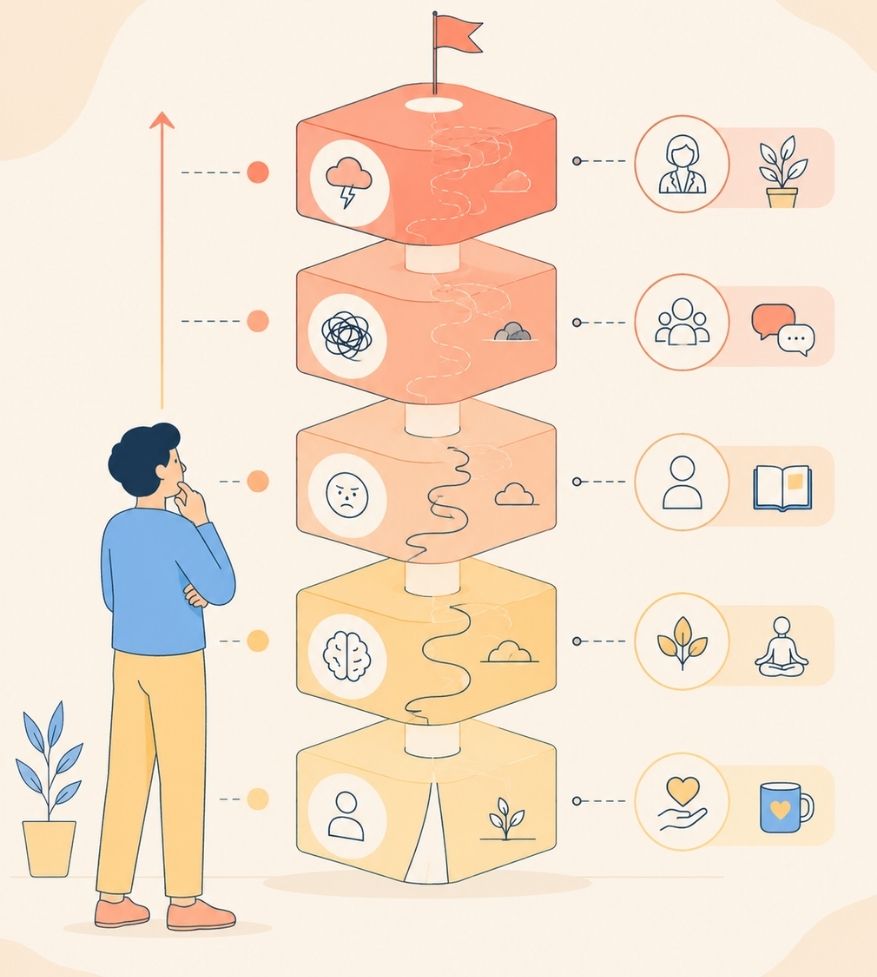
The type of support you need often depends on the level of impact
Before we go further, something important:
When we use terms like mild, moderate, severe, or complex, we are not ranking people’s suffering.
A “mild” accident can still significantly affect someone’s sleep, concentration, relationships, confidence, emotional regulation, or nervous system. And someone with severe injuries is not somehow more deserving of care than someone whose impact is less visible.
These categories simply help match the right level of support to the right level of need.
For many people after a motor vehicle accident in Alberta, the psychological impact falls somewhere in the mild-to-moderate range.
That can look like:
- disrupted sleep
- emotional overwhelm
- irritability
- feeling mentally exhausted
- anxiety while driving
- relationship strain
- difficulty concentrating
- feeling unlike yourself
- functioning outwardly, but struggling internally
In many of these situations, a counsellor or counselling therapist is often an appropriate first step.
Counselling can be especially useful when the goal is understanding the impact of the accident, improving day-to-day functioning, regulating the nervous system, receiving structured emotional support, and addressing concerns before they become heavier over time.
On the other hand, some people experience symptoms that are significantly more severe or clinically complex.
That may include:
- severe PTSD symptoms
- intense panic responses
- dissociation or feeling disconnected from reality
- major difficulty functioning day-to-day
- severe psychiatric instability
- significant cognitive impairment
- inability to safely work or manage basic responsibilities
In these situations, a clinical psychologist or psychiatrist may be the more appropriate level of care.
And this is important to clarify clearly: psychologists do not only provide assessments and testing.
Clinical psychologists also provide therapy — particularly for more severe, complex, chronic, or diagnostically layered mental health presentations where deeper psychological intervention, formal diagnosis, psychometric testing, trauma-focused work, or medico-legal involvement may be required.
The goal is not to qualify for help.
The goal is to match the level of support to the level of impact.
Pre-existing mental health conditions can change what kind of support fits best
This is something very few people talk about openly after an accident, but it matters.
Sometimes the accident itself is not the only factor involved. People may already have pre-existing mental health concerns, medication support, previous diagnoses, or an existing therapeutic relationship before the collision ever happened.
And that changes how support may need to be approached.
For example, if someone is already working through stress, anxiety, burnout, sleep concerns, or mild depression, counselling may still be a very appropriate fit after the accident — especially when the focus is understanding how the collision has affected emotional regulation, work capacity, relationships, and day-to-day functioning.
But if someone already has a more severe or complex psychiatric history involving psychotic disorders, dissociative disorders, severe PTSD, bipolar instability, active psychiatric care, or significant medication management, then continuing care with a clinical psychologist, psychiatrist, or more specialized mental health team may make more sense.
And sometimes, people work with both.
A psychologist may support formal diagnosis, trauma-focused treatment, or more complex therapeutic work, while a counsellor supports the ongoing emotional and functional recovery process between those larger assessment points.
These roles are often more collaborative than people expect.
Do I need a diagnosis before I can get support after my accident?
No.
And this is one of the biggest misconceptions people have after motor vehicle accidents.
Many people assume support only becomes valid once there is a formal diagnosis attached to it.
That is not true.
A diagnosis has a specific purpose. Formal diagnoses can help support:
- disability accommodations
- time away from work
- psychiatric treatment planning
- insurance or legal processes
- psychometric or medico-legal evaluations
And yes, if your symptoms are severe enough that PTSD, major psychiatric impairment, or long-term disability considerations are becoming part of the picture, then a clinical psychologist or psychiatrist becomes extremely important.
Especially if your case may eventually involve trial, formal legal opinions, or more complex insurance disputes.
But many people after an accident are not there.
Many people are simply trying to understand why everything suddenly feels harder than it used to.
If you are slowly getting back into your routine but your sleep feels disrupted, driving feels tense, work feels mentally heavier, emotional regulation feels harder, or your nervous system feels constantly “on,” counselling support can still be incredibly valuable even without a diagnosis.
Support is not reserved only for crisis.
What if I’m functioning… but clearly not functioning like myself?
This is probably where the majority of people quietly fall after an accident.
And honestly, this group often gets overlooked because outwardly, they still appear “fine.”
They are still working.
Still driving.
Still parenting.
Still attending appointments.
Still replying to emails.
Still showing up where they need to show up.
But internally, something feels different.
And because the injuries are not always dramatic or visibly obvious, people often underestimate how much the accident actually affected them.
So they try to force themselves back to their pre-accident baseline as quickly as possible.
That is usually where the struggle begins.
Because functioning is not always the same thing as recovering.
Many high-functioning people accidentally begin compensating instead of recovering.
They push harder.
Overperform.
Overcommit.
Minimize symptoms.
Tell themselves they should already be back to normal.
Whether you are navigating busy summer traffic through Banff or trying to settle back into your usual routines after longer drives outside Wetaskiwin, many Albertans quietly push themselves back into functioning long before their nervous system actually feels settled again.
And over time, that creates exhaustion.
Not because people are weak.
Because they are trying to operate at their old baseline while carrying an entirely new layer of physical, emotional, cognitive, and nervous-system strain underneath it.
This is one of the biggest reasons counselling can be so helpful after a motor vehicle accident.
Not because someone is incapable of coping.
But because having a structured space to understand the impact, accept the impact, and adapt to the impact can stop people from quietly exhausting themselves trying to outrun it.
What counselling after a motor vehicle accident can actually feel like
A lot of people hesitate to begin counselling because they imagine it will immediately become deeply emotional, overwhelming, or intensely introspective.
In reality, counselling after a motor vehicle accident is often much more practical and recovery-focused than people expect.
For many clients, it becomes the first structured space where they stop trying to push themselves back to normal and actually slow down enough to understand what changed after the accident.
That may involve understanding:
- why driving suddenly feels mentally exhausting
- why sleep feels disrupted even when the body is exhausted
- why emotional tolerance feels shorter
- why work and relationships suddenly require more effort than before
- why the nervous system feels constantly “on” even when life appears functional from the outside
At The Minds Matter, the work is often focused on helping clients understand the emotional, functional, and nervous-system impact of the accident while building practical recovery supports around it.
Depending on the client and the stage of recovery, sessions may integrate grounding approaches, nervous-system regulation strategies, breathwork, reflective processing, practical recovery planning, and supportive tools that clients can continue using between sessions.
The goal is not to make your life revolve around therapy.
The goal is to help recovery feel more understandable, more supported, and less isolating while you move through it.
What about accessibility, wait times, and cost?
This is one of the most practical parts of the decision-making process, and honestly, it matters.
Some Albertans begin with counselling simply because they are able to access support sooner.
Depending on location, psychologist availability, and the level of assessment required, wait times for psychological services can sometimes be longer — especially in smaller communities outside larger urban centres.
Cost also plays a practical role in decision-making.
In Alberta, counselling sessions commonly range somewhere between approximately $140–$220 per session depending on the practitioner, structure, and services included.
Clinical psychologist sessions may commonly range between approximately $220–$300+ per session, while formal psychological assessments, psychometric testing, and medico-legal reports are often billed separately and may involve significantly higher overall costs depending on complexity.
That does not make one profession more legitimate than the other.
It simply means different services are designed for different levels of need.
And importantly, you do not need to perfectly predict your entire recovery journey from the beginning.
Many people start with one level of support and later adjust depending on how recovery unfolds.
What about insurance, legal files, and documentation?
This is another area where many Albertans feel confused.
Many people assume documentation is only useful if it comes from formal psychological assessment.
That is not accurate.
The type of documentation simply depends on the purpose of the documentation.
For example:
- psychologists may provide psychometric testing, formal assessments, diagnoses, therapy for complex presentations, and medico-legal opinions
- counsellors may provide functional documentation, treatment summaries, recovery observations, emotional impact tracking, and structured clinical documentation within counselling scope
At The Minds Matter, clients who begin MVA counselling receive a Clinical Snapshot after their first session.
This is a structured document that may include:
- functional impacts
- emotional and nervous system observations
- baseline patterns
- screening indicators where appropriate
- a non-diagnostic clinical impression within counselling scope
This documentation can become especially important because Alberta’s insurance landscape is evolving, including increasing conversations around no-fault insurance models and stronger emphasis on functional impact documentation over time.
Early documentation helps create a clearer recovery timeline while experiences are still recent and easier to track accurately.
And depending on the complexity of the case, some clients may later work alongside psychologists, lawyers, physicians, physiotherapists, or insurers as part of a larger recovery process.
What if I’m scared this will turn into long-term therapy?
This fear is far more common than people realize.
A lot of high-functioning adults hesitate to seek support because they worry it means:
- opening up their entire life story
- becoming emotionally overwhelmed
- getting stuck in therapy indefinitely
- opening parts of life they are not ready to unpack
But motor vehicle accident counselling does not always work that way.
In many cases, the work is intentionally focused on the impact of the accident itself:
- sleep
- driving
- nervous system regulation
- emotional overwhelm
- irritability
- work functioning
- relationship strain
- recovery adjustment
For clients who want a more structured approach, The Minds Matter also offers an MVA Recovery Program — a contained five-session counselling structure focused specifically on the impact of the accident and the recovery process itself.
The goal is not to pull apart your entire life.
The goal is to help you understand and support the parts of your life that changed after the accident.
What kind of support are you actually looking for right now?
At this point, you may already have a clearer sense of what kind of support fits where you are right now.
Some people reading this article may realize they need formal assessment, diagnosis, or psychologist-led care because the impact of the accident has become severe, clinically complex, or significantly impairing.
Others may realize they need a structured space to understand what changed, support their nervous system, document the impact early, and receive focused support before the strain becomes heavier over time.
Neither path is more legitimate than the other.
They are simply different forms of care designed for different levels of need.
A lot of people after motor vehicle accidents continue functioning outwardly while quietly struggling underneath the surface — mentally, emotionally, physically, and relationally. And because they are still functioning, they often convince themselves they should simply keep pushing through it.
But recovery is not only about continuing to function.
It is also about understanding what the experience has actually cost you, and allowing yourself the appropriate level of support for that impact.
And whether you are recovering in a larger city or somewhere quieter near Athabasca where support can already feel harder to access, you still deserve care that matches the reality of what this experience has actually been like for you.
FAQ
Do I need a referral to start counselling after a car accident in Alberta?
No. You can directly book with a Canadian Certified Counsellor (CCC) or Counselling Therapist without needing a physician referral first.
Will insurance cover counselling after a motor vehicle accident?
Coverage depends on your specific situation, including your extended health benefits, the nature of the accident, and your insurer’s approval processes.
Some clients use:
- extended health benefits
- Section B accident benefits
- private pay with reimbursement possibilities later
Direct billing options may also be available depending on your coverage and treatment setup.
Can counselling documentation still help my legal or insurance file?
Yes.
Counselling documentation can help establish:
- early functional impact
- emotional and nervous system changes
- recovery timelines
- ongoing treatment participation
At The Minds Matter, clients receive a Clinical Snapshot after their first session, which creates an early structured record of how the accident may be affecting day-to-day functioning.
What’s the difference between a counsellor and a psychologist after an accident?
Generally speaking, counsellors often support emotional processing, nervous system regulation, coping strategies, functional recovery, and structured support after an accident.
Clinical psychologists may additionally provide therapy for more severe or complex mental health presentations, formal diagnosis, psychometric testing, trauma-focused treatment, and medico-legal opinions.
The right fit depends on the level and complexity of impact.
What if I start with counselling and later realize I need a psychologist?
That is completely okay.
Many people begin with counselling and later step into more formal psychological assessment or psychologist-led care if recovery becomes more complicated than expected.
Recovery is not always linear, and support plans can evolve over time.
What happens in a first MVA counselling session?
Your first session is usually focused on understanding:
- what changed after the accident
- how the accident is affecting your daily functioning
- what symptoms or stressors are showing up
- what level of support may fit best moving forward
After the session, clients at The Minds Matter receive a Clinical Snapshot — a structured document summarizing presenting concerns, functional impact, and baseline observations within counselling scope.
Can I access MVA counselling virtually if I live outside a major city in Alberta?
Yes. Virtual MVA counselling is available across Alberta, making support more accessible for people living outside larger cities or for clients whose schedules, pain levels, or driving anxiety make in-person sessions difficult.
For many Albertans, virtual sessions reduce the strain of long drives, time away from work, childcare coordination, or additional travel during recovery.
Virtual counselling can also help clients who still feel uncomfortable driving after their accident, especially on highways or during busy traffic periods.

Anjali Nagda
Anjali Nagda is the Founder and Lead Clinician at The Minds Matter. She is a Canadian Certified Counsellor (CCC) and Registered Clinical Counsellor (RCC), offering virtual counselling to adults across Canada.
Related Blogs
No related blogs available.