Why The Minds Matter Is Holistic by Design
04 Feb 2026
Because human experience is never the same twice
This article explains how integrative counselling sessions at The Minds Matter adapt to real emotional and nervous system states, rather than following fixed therapeutic techniques.
When people explore my website, they often notice that I’m trained in counselling, hypnotherapy, breathwork, meditation, and coaching — all offered within counselling.
And a very reasonable question tends to follow:
“So… which one do I choose?”
This blog exists to answer that — and to gently take that responsibility off your shoulders.
Why this matters
After years of working with adults in clinical, integrative, and private practice settings — including addiction recovery, multidisciplinary healthcare, and online counselling — one thing has stayed consistently true:
Real people don’t arrive in therapy the same way every week.
Your nervous system doesn’t follow a schedule.
Your emotional capacity changes.
What you’re carrying shifts — sometimes subtly, sometimes all at once.
Because of that, the way I support you cannot stay fixed either.
You’re not coming to therapy to regulate yourself through one method.
You’re coming to be met by a clinician who can assess what’s present in that hour and respond in a way that is trauma-informed, ethical, and grounded in clinical judgment.
You don’t have to decide how the work should look.
That’s where I step in with my tool-kit.
Human experience changes — so sessions change
In my work as a Canadian Certified Counsellor and Registered Clinical Counsellor, this variation shows up every day.
Some days, clients arrive feeling clear enough to talk, reflect, plan, and make sense of what’s been happening.
On those days, conversation, insight, and meaning-making are genuinely helpful.
Other days, clients arrive:
- anxious
- depleted
- overwhelmed
- barely holding things together
When the nervous system is activated or overloaded, trying to think our way through it can feel like too much.
There are also days when:
- frustration or anger sits close to the surface
- emotions feel bottled, sharp, or heavy in the body
- words feel distant or hard to reach
A single therapeutic approach cannot meet all of these states.
That’s not a flaw in the client — it’s a reality of being human.
Why I trained in multiple modalities
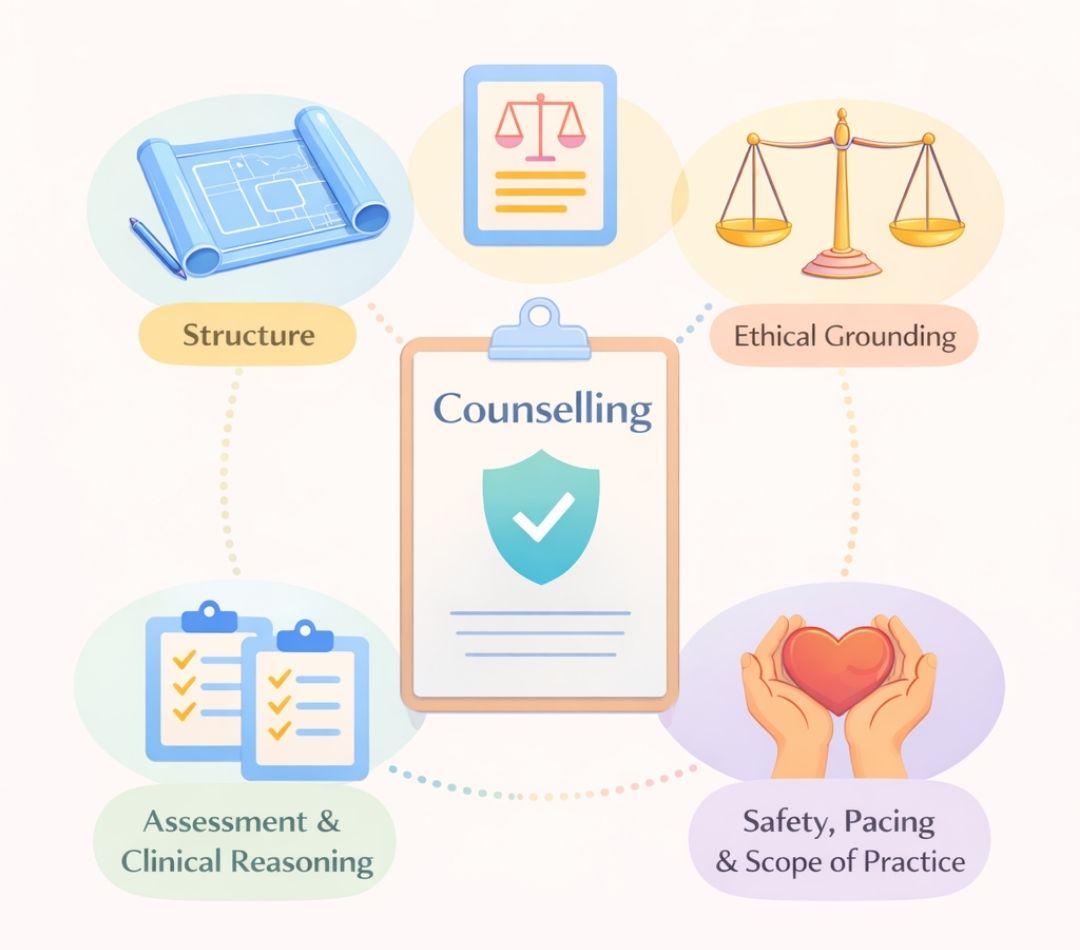
My foundation is clinical psychology and counselling.
That training provides:
- structure
- ethical grounding
- assessment and clinical reasoning
- attention to safety, pacing, and scope of practice
It’s also what allows my work to be recognised by professional regulatory bodies in Canada, and often eligible for extended health benefits and, for Alberta clients, motor vehicle accident (MVA) counselling coverage.
But clinical training alone doesn’t always reach where experience is actually being held — particularly when stress, trauma, or anxiety live more in the body than in words.
That’s why I pursued additional training in hypnotherapy, breathwork, meditation, and mind–body approaches through recognised programs in Canada and internationally.
Not to offer more services.
But to allow the work to become:
- felt, not just understood
- embodied, not just discussed
- regulating, not just insightful
- responsive, not rigid
I didn’t want clients — especially high-achieving professionals or those recovering from accidents or long periods of stress — to have to force their experience into one channel.
I wanted the support to meet the experience — wherever it shows up.
What sessions actually look like
Sessions are not pre-planned by modality.
I don’t decide in advance, “This will be a hypnotherapy session,” or “This will be a breathwork session.”
I decide in response to you — based on clinical assessment, nervous system cues, and what feels most supportive in that moment.
For example:
- When anxiety is high and the nervous system is struggling, grounding, breathwork, or guided regulation may come first — helping the body settle enough for the mind to follow.
- When insight is present but change feels stuck, hypnotherapy can support integration at a deeper, more embodied level — without forcing or over-efforting.
- When emotions feel intense, bottled, or restless, working with the breath and body can help process what’s being held — without needing to explain or justify it.
- And sometimes, the most important work is simply slowing down and creating safety.
There are also sessions where we talk the entire time.
There’s no formula — only responsiveness.
Counselling is the container
Everything I offer happens within a counselling relationship.
That means:
- informed consent
- clinical pacing
- ethical oversight
- emotional and psychological safety
Other approaches are tools within that container, introduced collaboratively and only when they feel appropriate.
Nothing is imposed.
Nothing replaces the relationship itself.
This is especially important in online therapy, where clarity, attunement, and trust matter just as much as technique.
Why I don’t offer these services separately
Offering everything in neat, separate boxes would require you to:
- self-diagnose
- decide what you “need” before we meet
- worry about choosing correctly
In my experience, that often adds pressure — particularly for people who are already overwhelmed or used to performing well.
Integration allows for:
- flexibility
- continuity
- responsiveness over time
- a sense of being held, rather than managed
You’re not booking a technique.
You’re booking my ability to assess, adapt, and guide the work in a way that fits where you are that day — grounded in both clinical training and lived therapeutic experience.
A simple way to picture the work
If it helps, imagine it like this:
Counselling is the main container — steady, ethical, and supportive.
Within it are different ways of working that can be drawn on as needed:
- conversation and reflection
- nervous system regulation
- breath and body-based support
- guided subconscious work
- moments of slowing down and rest
None of these are ranked.
None are required.
They’re simply available — so you don’t have to shape yourself to fit an approach.
Frequently asked questions
Do I need to choose a therapy method before starting?
No. You don’t need to decide whether you want counselling, hypnotherapy, or breathwork before we meet. Sessions adapt to what you’re experiencing in that moment, and any approaches used are introduced collaboratively and within counselling.
Is this still counselling if other approaches are used?
Yes. All sessions take place within a counselling framework, guided by clinical assessment, ethical standards, and professional scope of practice. Other tools are used only when supportive and appropriate.
What if I don’t know what I need?
That’s very common — and completely okay. Part of my role is to help assess what might be most helpful based on how you’re feeling, what you’re navigating, and what feels manageable that day.
Will sessions always involve techniques like breathwork or hypnotherapy?
No. Some sessions are entirely conversational. Others may involve regulation or mind–body support. There’s no expectation or requirement — only responsiveness.
If there’s one thing I want you to know
Your experience doesn’t have to match a method.
You don’t have to arrive calm.
You don’t have to know what you need.
You don’t have to explain yourself perfectly.
You’ll be met where you are — by someone trained to hold complexity — and guided from there.
That’s what holistic means here.

Anjali Nagda
Anjali Nagda is the Founder and Lead Clinician at The Minds Matter. She is a Canadian Certified Counsellor (CCC) and Registered Clinical Counsellor (RCC), offering virtual counselling to adults across Canada. Her work is grounded in clinical psychology and shaped by integrative, trauma-informed practice, supporting clients with anxiety, emotional overwhelm, and life transitions through ethically held, responsive counselling sessions.
Related Blogs
No related blogs available.