
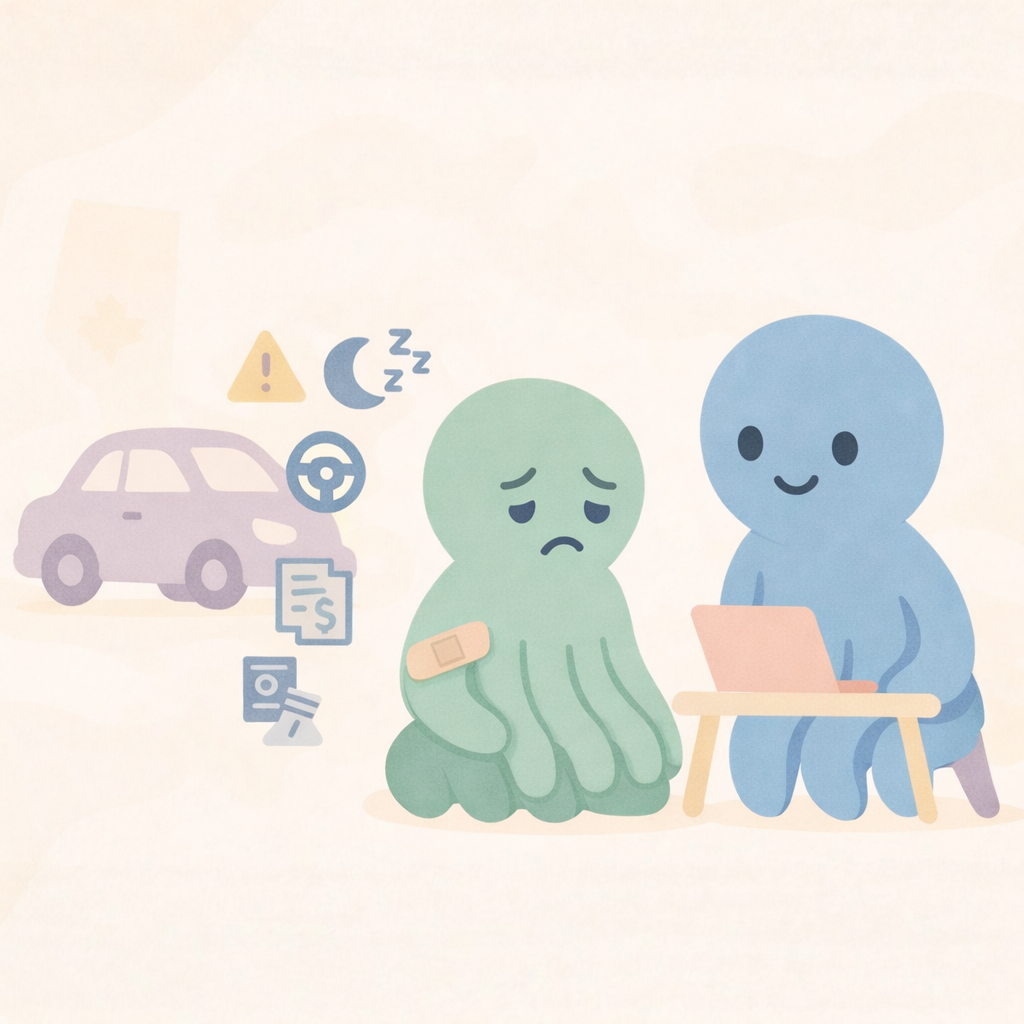
For a few seconds, you weren’t here. It might have happened in the middle of a grocery run, just as you reached for a box of cereal and the store speakers did something sudden. Or at a red light on an ordinary Tuesday, with the radio on and nothing out of place. Or on the couch on a quiet Sunday afternoon, blanket on your lap, absolutely nothing going on. Then, without warning, your body reacted as though the accident was happening right now. Your heart pounded, your hands went cold, and for a few seconds our body braced as if the danger were real and right in front of you, while some part of your mind was still trying to work out where you were.
Then it passed, and the room came back. You were left shaky and a little embarrassed, maybe checking whether anyone had noticed, and left with a racing pulse and one very big question: what was that, and does it mean something is wrong with me? If you’ve been quietly asking that, it’s very common! You are in very good company, even though it rarely feels that way from the inside. Flashbacks after a motor vehicle accident are far more common than most people realise, and far more often whispered about than said out loud.
Wait, What Just Happened to Me?
A flashback is so unsettling because it doesn’t feel like remembering. When you recall what you had for dinner last Thursday, you know it belongs to the past. A flashback skips that step. Your body responds first, with the same tension, the same racing heart, the same urge to brace, and your mind catches up a moment later, wondering why you’re gripping the edge of the table and why your coffee suddenly seems very far away.
For some people it arrives as a vivid scene, like a short film behind the eyes. For many others it’s quieter: a sudden wave of panic, a drop in the stomach, a heavy sense of dread with no obvious reason. Some people don’t “see” anything at all. They just feel strangely off for the rest of the afternoon and can’t work out why.
One way to picture it is a browser tab that keeps reopening. You close it, carry on with your day, and then it pops up again at the most inconvenient moment, like the world’s least welcome surprise party. It’s annoying and it can really rattle you, but it doesn’t mean your computer is ruined. It means something in there still needs a little attention before the tab will stay shut.
The Everyday Things Nobody Warns You About
Triggers can be surprisingly ordinary. A screech of brakes in a parking lot. A car horn two streets over. The smell of a hot engine, rain streaking down a windshield, or headlight glare on a winter evening when it’s already dark at four-thirty. Even a phone call from an insurance adjuster can do it, because it pulls the whole experience back into the room, uninvited, right in the middle of your Wednesday.
Then there are the flashbacks with no trigger at all, which are often the hardest to make sense of. You’re folding laundry, or standing in the shower, or lying in bed at the end of the day, and the memory arrives without being invited. Many people feel a bit perplexed by these. Nothing was even happening. Why did that happen? Quiet moments are often exactly when these things surface, because when your day finally stops, your mind gets a chance to catch up.
On the Road: When the Drive Home Isn’t Just a Drive
For many people, the road is where all of this shows up the most. Driving used to be something you did without thinking, the way you walk across a room. Now it might come with a running commentary. Your hands grip the wheel a little harder than they need to. Your foot hovers over the brake even when traffic is flowing nicely. A car merging slightly too close sends a jolt through your whole body that’s far bigger than the moment deserves.
You may also have started adjusting things without quite noticing. Taking the long way around a certain intersection. Leaving fifteen minutes early to avoid the highway. Signalling a full block before every turn, because you’ve become the most law-abiding driver in Alberta. But a twenty-minute drive can also leave you feeling as though you’ve run a marathon, because your body has been scanning, bracing, and adjusting the entire time. If you arrive tired, it isn’t because you’re out of shape. It’s because your nervous system has been working overtime and deserves some kindness afterwards.
If a flashback arrives while you’re driving, safety comes first. When it’s possible, signal, pull over somewhere calm, put the car in park, and give yourself a few minutes.
Here’s the hopeful part: the road is one of the places where people often notice the clearest progress. With time, gentle steps at your own pace, and the right support, many people go from white-knuckling a five-minute drive to singing badly along to the radio on the way home.
Why Your Mind Does This
Normally, when we go through an experience, the brain files it away with a little label that says this happened, it’s over. During a frightening moment, though, your brain goes into protection mode. All its energy goes toward keeping you safe, not toward neatly filing the details. Some memories end up a bit loose and a bit too close to the surface, like a drawer that doesn’t quite close. Every so often something bumps it and it slides open, and everything inside is right there as though it had never been put away.
Your body adds its own layer. After an accident, your alarm system can become oversensitive, like a smoke alarm that goes off every time you make toast. It isn’t broken, and it isn’t a weakness.Your body isn’t doing this to make things harder for you. It’s trying to keep you safe. After a scare like an accident, it learns to react quickly to anything that feels even a little similar, often before the thinking part of your mind has had a chance to say, it’s fine, we’re okay. That’s why you can know you’re safe and still feel your heart race. It also means your body can learn the difference again, gradually, with time and the right support.
So, Does a Flashback Mean PTSD?
Here’s the honest answer: it could, but it doesn’t have to. A single flashback, or even a handful in the weeks after an accident, doesn’t automatically mean you have post-traumatic stress disorder. Many people have strong reactions early on, and for a lot of them these ease as their sense of safety returns.
PTSD is a specific diagnosis, and it looks at the bigger picture rather than one moment. A professional would usually want to understand whether the memories keep returning through flashbacks, nightmares, or unwanted thoughts, whether you’ve started avoiding roads, driving, or conversations connected to the accident, and whether your mood has shifted, with more guilt, numbness, or distance from people you love. They would also ask whether you feel constantly on edge or unable to sleep, and whether this has continued beyond the first month and begun to get in the way of daily life. Those questions describe a pattern over time. One flashback is a piece of information, not a verdict, and you can’t reliably sort out which it is by searching symptoms at two in the morning. That’s exactly what a conversation with a qualified professional is for.
It’s also possible to have difficult reactions without meeting the full criteria for PTSD, and those still deserve care. If you catch yourself thinking other people had it much worse, please gently question that. Distress isn’t a competition, and you don’t need a label to deserve support.
What Helps, and When to Reach Out
When a flashback arrives, the aim isn’t to fight it. It’s to remind your body that right now, in this room, you’re safe. Press your feet into the floor and notice the ground holding you up. Slowly name a few things you can see, a blue mug, a window, a set of keys, a plant that really needs watering. Breathe in for a count of four and out for a count of six, because the longer breath out tells your body it can ease off the alarm. Quietly tell yourself today’s date and where you are: that was then, and this is now.
It can also help to tell one trusted person. You don’t need a speech. Something like “I’ve been having moments where it feels like the accident is happening again, and I just wanted someone to know” can lift a surprising amount of weight. And for one small thing to try this week, spend sixty seconds each day noticing where you are and naming a few things that tell you it’s today and you’re safe. It builds the habit of coming back to the present, which is exactly what you’ll reach for when a flashback appears.
You don’t have to wait until things feel “bad enough” to reach out. If the flashbacks keep coming, if you’re avoiding driving or places you used to enjoy, if sleep has become a struggle, or if daily life is starting to feel the strain, it’s a good time to talk with someone. And if things ever feel like too much, please reach out right away. In Canada, you can call or text 9-8-8 at any time, day or night.
Here’s the hopeful part, plainly. Flashbacks are one of the most understood experiences after an accident, and with time, practical tools, and someone in your corner, they tend to lose their grip. The calm stretches get longer and easier to trust, and the tab that kept reopening starts to stay closed for days, then weeks. Counselling isn’t about forcing you to relive anything. It’s a steady, supportive space to make sense of what your mind and body have been doing, at a pace that works for you.
Right now it may feel like a flashback can ambush you at any time. It doesn’t have to stay that way. With the right support, these moments tend to come less often, hit less hard, and pass more quickly. If you’d like to understand yours a little better, you can start at The Minds Matter, learn how MVA counselling in Alberta could help you, or look at our MVA Recovery Program, where you can meet others who know what these moments are like.