
How to Start Your Mental Health Recovery After a Car Accident in Alberta — A Step-by-Step Guide
08 May 2026
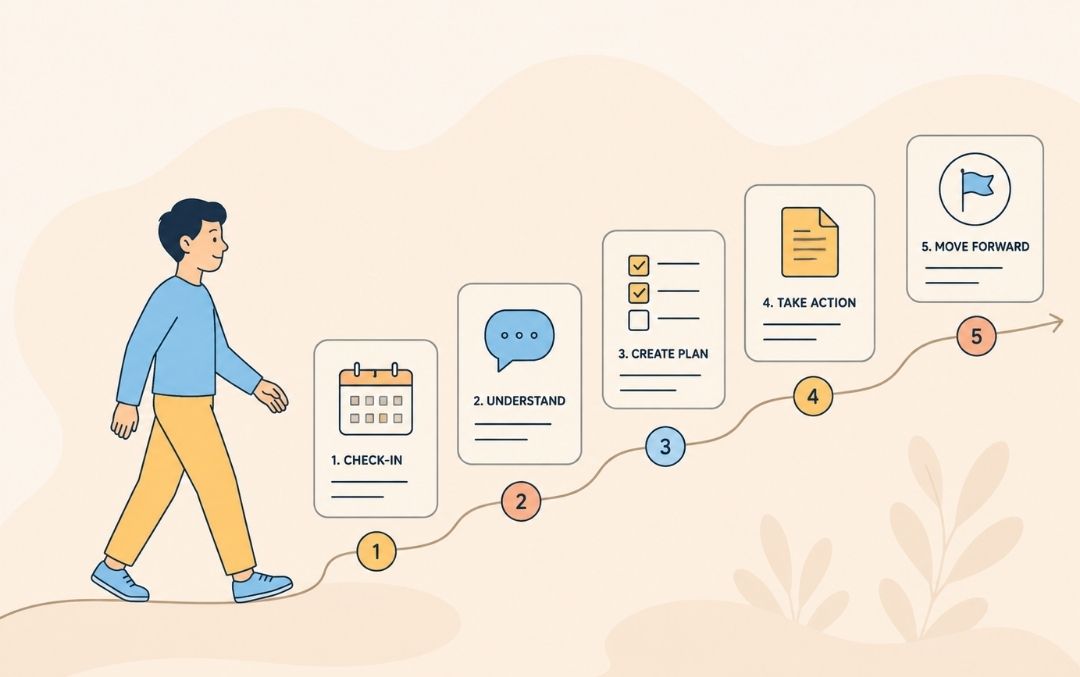
After a car accident, most people know what to do for their body.
You see a doctor.
You book physio.
You follow the treatment plan.
You deal with your insurer.
There’s a system.
The mental health side doesn’t come with that.
So the most common question becomes:
“Where do I even start?”
Closely followed by:
- “This feels like one more thing to coordinate.”
- “I don’t know if I have the bandwidth for this.”
- “What if this turns into something long and complicated?”
And because there’s no clear entry point, most people don’t start at all.
Not because they don’t care.
Because it feels like stepping into something bigger than they want.
What this guide will actually help you do
- understand what “starting” really means (and what it doesn’t)
- avoid overcomplicating the process
- choose the right kind of support early
- get clarity without committing to something long-term
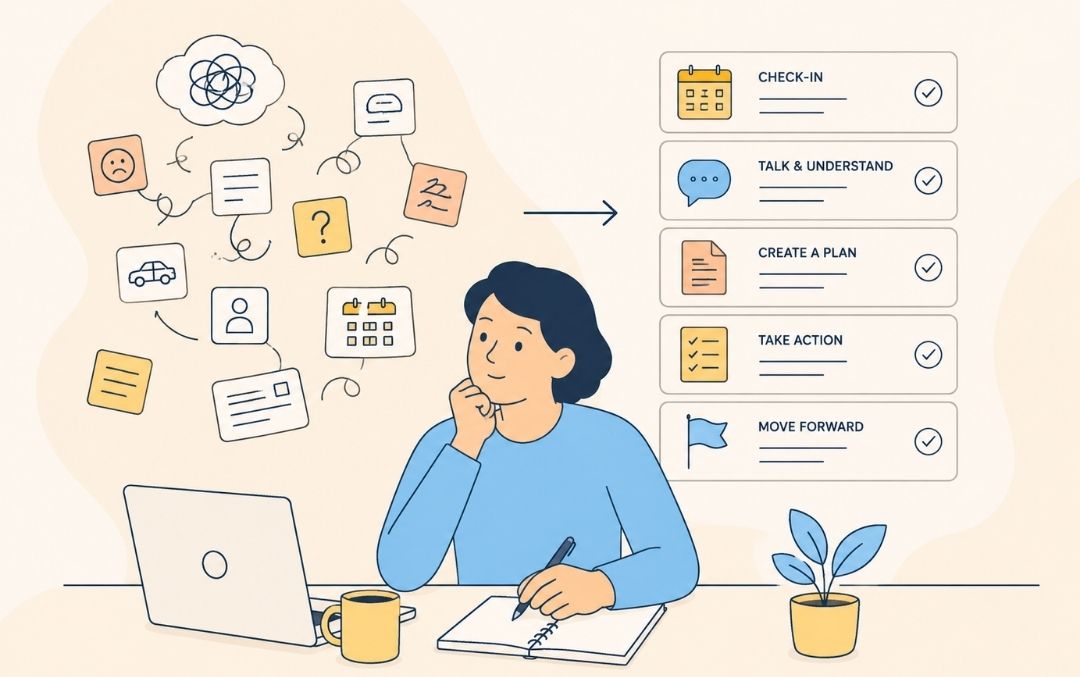
Step 1: Start with a check-in — not a commitment
Most people assume that starting mental health support means:
- committing to therapy
- unpacking everything
- opening up parts of life they’re not ready to go into
That’s where the hesitation comes from.
But that’s not what starting looks like here.
You don’t need to commit to therapy. You need a check-in.
The same way you’d check in with a doctor after an accident—even if nothing looks serious—you can check in mentally.
A first session is simply:
- you explaining what happened
- a clinician asking structured questions
- understanding what, if anything, has shifted
No long-term commitment.
No overreach.
No “opening everything up.”
Just clarity.
Step 2: Don’t wait until it feels serious
Most people delay because it doesn’t feel urgent.
“I’m managing.”
“It’s not that bad.”
“Let me just give it time.”
And in a busy place like Calgary, where work doesn’t really slow down for you, that logic makes sense.
You keep going. You stay functional. You push through.
But what often happens is:
- things take more effort than before
- your system stays slightly on edge
- small changes quietly become your new normal
By the time it does feel worth addressing, it’s harder to trace what changed and when.
Step 3: Stop assuming this has to turn into long-term therapy
This is one of the biggest internal blocks.
People think:
“If I start this, I’ll have to keep going.”
“What if this opens things up that I don’t want to deal with right now?”
That fear is valid.
And it’s also avoidable.
Because support doesn’t have to be open-ended.
Step 4: Understand the difference — open therapy vs a contained recovery program
Not all therapy is the same.
What most people are trying to avoid is:
- long-term, open-ended therapy
- going into unrelated areas of life
- feeling like they’ve opened something they now have to keep working through
That’s not what MVA-focused work needs to be.
At The Minds Matter, there is a Motor Vehicle Accident Recovery Program designed specifically for this:
A 5-session structured clinical container
focused only on the impact of the accident
That’s it.
Within this container:
- you look at how the accident affected you
- you understand the psychological and functional impact
- you work through what’s actually relevant
- you track changes across those sessions
And just as importantly:
it does not extend into other areas of your life unless you choose it to
This matters for clients who are:
- high-functioning
- managing work and responsibilities
- not looking to “go into everything”
- just wanting to address this one event properly
It gives you a clear boundary:
We are here to work on the accident. Nothing beyond that.
Step 5: Don’t overcomplicate logistics before starting
Another reason people don’t begin:
“I need to figure out insurance first.”
Which turns into:
- calls with adjusters
- waiting for approvals
- uncertainty about coverage
Meanwhile, nothing actually starts.
What you need is a simple approach:
Extended health benefits
- If available, check if counselling is covered
- If yes, you can begin immediately
Section B
- May apply, but often requires approval
- Typically comes into play after initial documentation
Private pay
- Allows you to start without delay
- Documentation is still provided
If you’re in a place like Red Deer, where coordinating between providers already takes effort, adding more delay at the starting point only makes it harder.
You don’t need a perfect plan. You need momentum.
Step 6: Book a first session (this is where things become clear)
The first session is not where everything gets opened up.
It’s where things get organized.
You understand:
- what has changed since the accident
- how it’s affecting your functioning
- whether anything needs attention
- what level of support actually fits
From there, you decide:
- stop there with clarity
- continue with a few sessions
- or step into the 5-session recovery program
But that decision comes after you understand what’s happening.
Not before.
Step 7: Start early — even if you’re still managing
Waiting feels easier in the short term.
But it creates gaps later:
- no early record of impact
- harder to explain changes
- more friction with insurers if symptoms show up later
Starting early doesn’t mean something is wrong.
It means:
you’re giving yourself a clear starting point
And if nothing develops, you move on with certainty.
If something does, you’re already structured around it.
Closing
Starting mental health support after a car accident doesn’t have to be:
- long-term
- overwhelming
- or all-consuming
It can be:
- one conversation
- or a five-session focused process
- contained, structured, and specific to the accident
You don’t have to open everything to address something.
You just have to start in a way that fits your capacity.
FAQs
I don’t know where to start. What’s the simplest first step?
Book a single session.
Not to commit—but to understand what’s changed. That one conversation usually replaces confusion with clarity.
I don’t want to get pulled into long-term therapy. Is that avoidable?
Yes.
The 5-session MVA Recovery Program is a contained clinical process focused only on the accident. It does not expand into other areas unless you choose to.
What if this adds more stress to my plate?
Most clients experience the opposite.
A structured session reduces mental load by organizing what you’ve been trying to figure out on your own.
Do I need to see a psychologist first?
Not in most cases.
For mild to moderate impact, a counsellor is the appropriate starting point. A psychologist is typically needed when diagnosis or complex assessment is required.
Will starting early actually make a difference?
Yes.
It creates a clear, early understanding of your baseline. That becomes important if symptoms evolve later—both for your recovery and for your file.
What if I’m functioning fine right now?
That’s often when support is most useful.
Because you can understand what’s changed before it turns into something harder to track or explain.

Anjali Nagda
Anjali Nagda is the Founder and Lead Clinician at The Minds Matter. She is a Canadian Certified Counsellor (CCC) and Registered Clinical Counsellor (RCC), offering virtual counselling to adults across Canada.
Related Blogs
No related blogs available.