
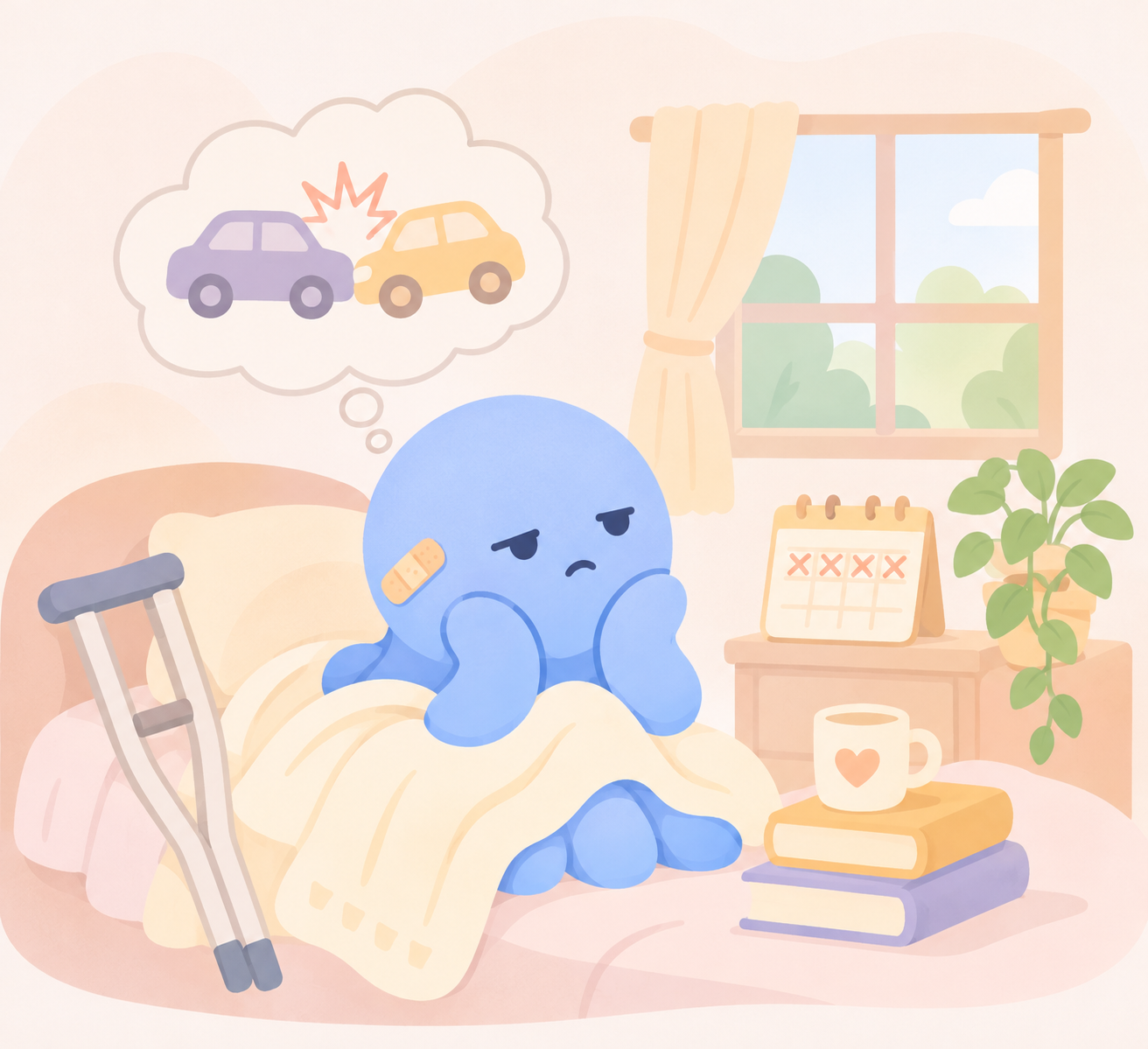
At some point in recovery, usually around the second or third week of lying low, you notice the clock. It's two in the afternoon, and it feels like it has been two in the afternoon for hours. You've checked the window, the fridge, and your phone, and nothing has changed. The house is quiet, the day is wide open, and there is absolutely nothing you're able to do with it.
It never makes it into the discharge notes. People warn you about pain, about appointments, about how long things might take. They rarely mention that one of the hardest parts can be the stretch of empty hours in between, and the strange, restless ache that comes with them.
The Day That Won't Move
Before the accident, your days probably had a pulse. There was the alarm, the commute, the meetings or the school run, the dinner, the shows you watched in the evening. Time moved because you were moving. Now, with your body or your head asking you to take it slowly, time seems to have stopped moving along with you. Mornings feel long. Afternoons feel longer. Winter in Alberta doesn't help, with the light fading by late afternoon and the cold keeping you indoors, so the day can feel like a long hallway with no doors.
It gets stranger when the usual ways of passing time stop working. Maybe screens make your head pound, or reading the same page three times leaves you more tired than when you started. Maybe the television is too loud, too bright, or too much. You end up doing what many people do, staring out the window, watching a neighbour shovel snow, counting the cars that go by. It might feel almost comical, and then, a little later, it might feel sad.
A typical day might go like this. You wake up, have breakfast, and look at the clock to find it's only ten. You rest, read a paragraph, and rest again. You wander to the kitchen for no reason, open the fridge, close it, and wander back. By noon you've had three small tasks and a lot of silence, and the rest of the day is still sitting there, waiting for you to do something with it.
This kind of boredom is different from the ordinary kind. It isn't the pleasant restlessness of a lazy Sunday, because you can't just get up and go for a walk or call a friend and make plans. The choice has been quietly taken out of your hands, and that makes the quiet feel less like rest and more like waiting for something you can't name.
Bored and Guilty at the Same Time
Then comes the guilt, which sneaks in behind the boredom like a second visitor nobody invited. I should be grateful I'm okay. Other people have it so much worse. What kind of person gets bored while recovering? It's a very common thought, and it tends to make things heavier. Now you're not only restless, you're also ashamed of being restless, which gives you something else to feel bad about.
Boredom can also come out sideways, in ways that surprise you and the people around you. You might feel irritable with those closest to you, snapping over small things, or find yourself drifting into scrolling that leaves you more tired than before. You may feel a flash of envy when you hear the neighbour leave for work, or a stab of sadness watching friends post about weekends you can't join. Some people start to feel almost unreal, as though they've been put on a shelf while everyone else carries on with life.
Friends and family can add to it without meaning to. Someone says, "Enjoy the rest, I wish I had time off," and you smile while thinking that this isn't the holiday it looks like. Rest that's forced on you feels very different from rest you've chosen, and it's easy to feel misunderstood when others see only the free time and not the restlessness underneath.
It might help to know that boredom isn't a sign you're doing recovery wrong. It's often a sign that your mind is sharp and curious and wants something to chew on, and that it's been asked to sit very still. Wanting more from your day isn't ingratitude. It's your mind telling you it's still in there, and still wants to be used.
What the Busyness Used to Cover
There's another side to boredom that few people mention. When life is full, it also keeps some thoughts at a comfortable distance. Between the emails, the errands, and the noise, there was always something to attend to, so there was rarely a gap for the heavier feelings to slip through. Now that the gaps are wide, they find their way in. The memory of the accident, the worry about money, the question of when you'll feel like yourself again, all of it has more room to move around.
That can make the quiet hours feel less like boredom and more like a mild dread. Some people find that their mind starts going in circles, replaying the same thoughts at two in the afternoon that it would normally have been too busy to notice. Others realise how much they relied on being busy to feel okay, and how unsettling it is to sit with themselves without a task to hold.
Even small things can feel loud in a quiet house like the tick of the clock, the hum of the fridge, the pause between one car passing and the next. With fewer distractions, your attention turns inward, and you notice every ache, every worry, and every thought that would normally have drifted by unnoticed.
If that's you, there's nothing wrong with you. It's simply what happens when a full life suddenly gets quiet. The goal isn't to fill every minute to escape it. It's to find gentle ways to keep your mind company, so that the quiet has something soft in it instead of something sharp.
Low-Demand Ways to Fill the Hours
The trick with this kind of boredom is to think small and gentle. You're not looking for a project, you're looking for something that asks very little of your body and your head, but still gives your mind something to hold. Many people find audiobooks or gentle podcasts a lifeline, since they don't need your eyes. Colouring, simple puzzles, or sorting a single drawer can give your hands a task without overwhelming you. Listening to music with your eyes closed, sitting by a window with a hot drink, or going out to the front step for ten minutes of fresh air can reset a long afternoon.
It also helps to bring in a little company and a little purpose. A short phone call with someone who makes you laugh, a handwritten note to a friend, or a plan to cook one simple thing can all break up the day. Some people keep a small list of easy activities on the fridge, so that when boredom hits, they don't have to think. Some people try the five-minute rule: pick something small, like watering the plants or sketching the view from your window, and give it five minutes only. If you want to carry on, you can. If not, you’ve still done something, and that quiet sense of having done something often lifts the afternoon more than you’d expect. If screens, reading, or noise tend to flare your symptoms, it's worth checking with your care team about what's right for you, since everyone's limits are different.
It can also help to give the day a gentle shape. Nothing rigid, just a few anchors, like a morning drink by the window, a short sit outside at lunch, and something small to look forward to in the evening. When the day has a few landmarks, the hours between them feel shorter. It doesn’t need to be impressive, and nobody is grading it. A day that includes one pleasant thing you chose is already a better day than the one that simply happened to you.
When the Quiet Starts to Feel Heavy
Sometimes boredom is only boredom, and it passes as your energy returns. But sometimes it slips into something heavier. If you notice that you've stopped looking forward to anything, that the days all feel flat, that you're sleeping more or less than usual, or that a quiet sadness has settled in, it may be more than the hours dragging. Low mood often arrives quietly during long stretches of recovery, and it's worth taking seriously, not because anything is wrong with you, but because you deserve to feel better than this.
It's also worth mentioning that long, quiet stretches can make worries louder. If your thoughts keep circling, if the evenings feel especially hard, or if you find yourself dreading the empty hours, that's a good reason to talk with someone. You don't need to wait until things feel dramatic.
Talking to a counsellor can be a gentle help here. It gives you a regular hour that isn't about pain or paperwork, a place to say what the quiet has been like, and to work out what would make your days feel a little fuller. For many people, simply having something to look forward to each week changes the shape of the whole stretch.
If you're in Alberta and the long quiet has been wearing on you, you can reach out through The Minds Matter, read about MVA counselling in Alberta, or see whether our MVA Recovery Program feels like a good fit. The days may feel slow right now, but they won't stay this empty, and there's nothing wrong with wanting them to be fuller. Your mind is asking for company, and it deserves an answer.