
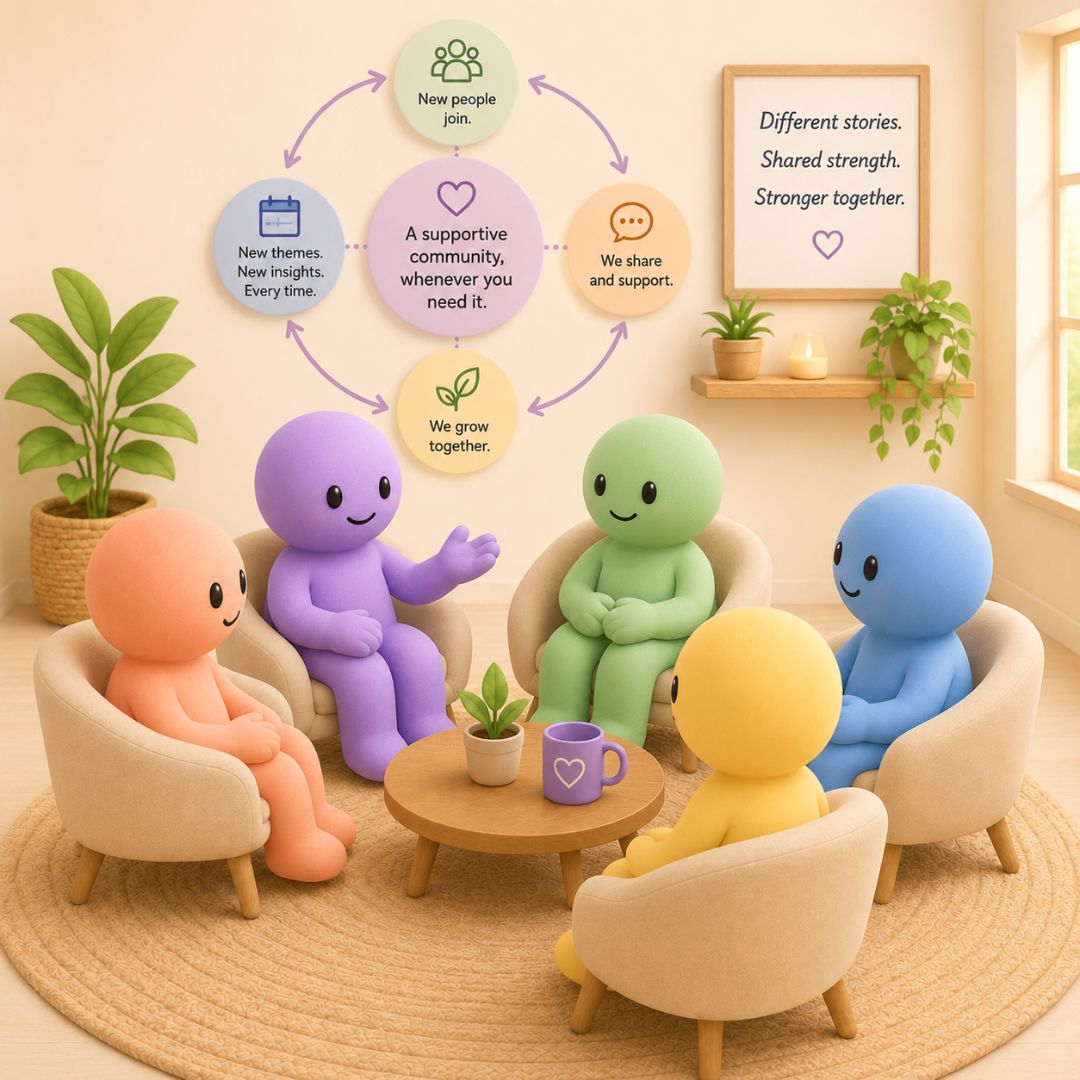
As I started training in group work, I began noticing something that felt very different from the work I was used to doing one-on-one. I had spent years sitting across from people and creating a space where they could slow down, go deeper into their own lives, make sense of what had happened to them, and say things they hadn’t been able to say anywhere else. I believe deeply in that work. But sitting in a group and watching people speak, listen, recognize themselves in one another, and slowly become more comfortable being seen made me realize that there is another kind of depth available Somewhere along the way, as I started training in group work, I began noticing something that felt very different from the work I was used to doing one-on-one. I had spent years sitting across from people and creating a space where they could slow down, go deeper into their own narratives, make sense of what had happened to them, and say things they hadn’t been able to say anywhere else. I believe deeply in that work. But sitting in a group and watching people speak, listen, recognize themselves in one another, and slowly become more comfortable being seen made me realize that there is another kind of depth available in recovery.
There is something that happens when you sit in a circle with the intention of talking about things we don’t usually talk about. Pain, grief, anger, fear, and the strange little changes that happen to your life after something disrupts it. Things that can feel difficult enough to say to one person can feel entirely different when someone else in the room is quietly nodding because they know exactly what you mean. You don’t have to explain every part of the experience before someone understands it. Sometimes, they already do.
Being witnessed takes courage. So does witnessing someone else. There is something surprisingly vulnerable about letting another person see you in the middle of something that isn’t resolved yet, and there is something equally powerful about being trusted enough to sit with someone else’s difficult moment. In group work, you aren’t only the person receiving support. You can also become part of someone else’s support system, even while you’re still finding your own way through recovery.
That changed something in the way I thought about my role as an individual therapist. Individual therapy allows for a kind of depth that is deeply personal—the opportunity to stay with your own narrative, your beliefs, your fears, your relationships, and the parts of your experience that need more room. Group work asks something different of us. It brings the social world back into the room and creates an opportunity to experience what it is like to be supported by people who are not simply trained to understand your experience, but are living through parts of their own.
I began to think about how little access many people have to that kind of recovery. We talk about pain. We talk about treatment. We talk about getting better. But there are fewer spaces where someone’s grief can simply be witnessed, where their anger doesn’t need to be tidied up, or where they can say, “This is harder than I thought it would be,” and have someone else respond, “Yes. Mine too.”
And there is another piece of group work that I hadn’t fully appreciated before: agency. There is a difference between being the person who needs support and being someone who can also offer it. You can walk into a room carrying something heavy and still have something to contribute to another person’s experience. Sometimes it is a story, sometimes it is an idea, sometimes it is simply a nod that says, I know what you mean. That shift can be powerful. You are not only someone recovering; you are also someone capable of being part of another person’s recovery.
When Recovery Needs a Social Space Too
That is what began to make group work feel important to me—not because it is better than individual therapy, and certainly not because individual therapy is somehow insufficient, but because it offers access to something different. As an individual therapist, I was often helping people understand and work through what was happening inside them. As a group facilitator, I am also interested in what happens between people: how we reconnect, how we recognize ourselves in others, how we let ourselves be seen, and how we slowly find our way back into a social world after something has disrupted it.
That distinction became especially meaningful to me when I thought about motor vehicle accident recovery. An accident can change more than your body or your routine. It can change how you move through public spaces, how you relate to driving, how much energy you have for other people, and how connected you feel to the life you were living before. Social rehabilitation asks for something different from individual therapeutic work. Sometimes, part of moving forward is not only understanding your own experience, but having somewhere to experience it alongside other people.
A Room Full of People Can Hold Something One Chair Can’t
Individual therapy is where I’ve spent most of my career, and I believe deeply in it. It’s where you get to slow down and really unpack yourself, your patterns, your fears, the narratives and beliefs you’re carrying knowingly or unknowingly, the parts of it you haven’t said out loud to anyone yet.
But every so often, a session would end with something a client said almost in passing, and it would stay with me long after they’d left. I remember one client, months into their recovery from a car accident, saying, “I know you get it, but you’re not scared to merge onto the highway- are you?.” It wasn’t a criticism. It was just true.
There’s something almost physical about the moment when someone finally hears their own experience said out loud by a person who isn’t their therapist, but who’s actually lived it. A kind of relief that says, oh. I’m not the only one. Hearing someone else say out loud an experience you’d assumed was yours alone does something a one-on-one conversation doesn’t, no matter how much trust has been built there. It only happens with other people who know exactly what you mean before you finish the sentence—people who’ve also sat frozen at a green light, or flinched at the sound of a horn two streets over.
We’re Never Really Doing Anything Alone Anyway
Here’s a slightly embarrassing confession: it took me longer than I’d like to admit to connect this dot, given how obvious it is once you actually look at it.
Think about your own life for a second. Family dinners. Group chats that never stop buzzing. Work meetings. Sports teams. Book clubs where you technically discuss the book for ten minutes and then talk about everything else for an hour. We are, almost embarrassingly, group creatures. We process practically everything—good news, bad days, existential spirals about our thirties—by turning to other people and saying, “wait, does anyone else feel this way?”
So then why does recovery so often get treated like the one exception? Like it’s supposed to be this solitary, quiet, one-person-and-one-therapist kind of process, when literally everything else in our lives runs through other people?
One client put this better than I ever could. She told me about calling a friend to talk through a rough week, only to end up comforting the friend instead—because the friend got visibly uncomfortable and didn’t know what to say, so she found herself saying “it’s fine, don’t worry about it,” just to smooth things over. She hung up feeling more alone than before she’d called. That’s the gap this group work is built to close. Not because friends and family don’t care, but because they haven’t lived it. A room of people who have lived it doesn’t need you to manage their discomfort. They just get it.
Learning to Do This Properly
I didn’t want to just add a few extra chairs to what I already do and call it a group. Facilitating a group is an entirely different skill from sitting one-on-one with a client—the pacing is different, the pull toward comparison between members is real, and knowing when to let silence sit versus when to step in changes completely once there’s more than one person in the room.
I’d been wanting to explore group work for about two years before I did anything about it. When the chance finally came, I went through an intensive group facilitation training alongside fifteen other mental health professionals, all of us learning together, all of us occasionally getting it wrong in supervised practice sessions before getting it right. I’m still in supervision now, still learning. I wanted to actually learn the craft, not assume it would come naturally just because I’m used to sitting across from someone individually.
When we were asked, as part of the training, to build a group around something we genuinely knew and cared about, MVA recovery was the obvious place for me to start. I’ve sat with enough clients rebuilding their lives after an accident to know how quietly isolating that road back can be. People doing everything right—going to every appointment, doing the exercises, following every piece of advice their doctor and lawyer and physiotherapist gave them—and still feeling like nobody around them actually understands what they’re carrying. It’s a strange kind of loneliness, because from the outside, it can look like recovery is going fine. On the inside, it often doesn’t feel that way at all.
Not Instead Of. Alongside.
This isn’t about replacing individual therapy—it never was. Some things are still best worked through one-on-one, in a space where the focus stays entirely on you, your experience, feelings and fears. What group work offers is something different: another kind of room, one where you can recognize pieces of your own story in someone else’s, learn from how they’ve gotten through a hard week, and realize you’re not the only one navigating this particular stretch of road. That you’ve got more people, your people with you for this uneven patch.
I think about the client who apologized to a friend on the phone instead of the other way around, and I imagine what it might feel like for her to say the same thing in a room full of people who wouldn’t need that apology at all—people who’d simply nod, because they’ve been there too. I think about the client who told me they needed someone who was also scared to merge onto the highway, and I imagine what it might mean for them to hear someone else in the room admit the exact same fear, unprompted, in their own words.
I don’t know yet exactly what this group will become. That part excites me. But I keep coming back to one thought, and maybe it’s worth sitting with for a second yourself—recovery doesn’t have to be something you carry alone. Sometimes, it might just be easier to walk together.